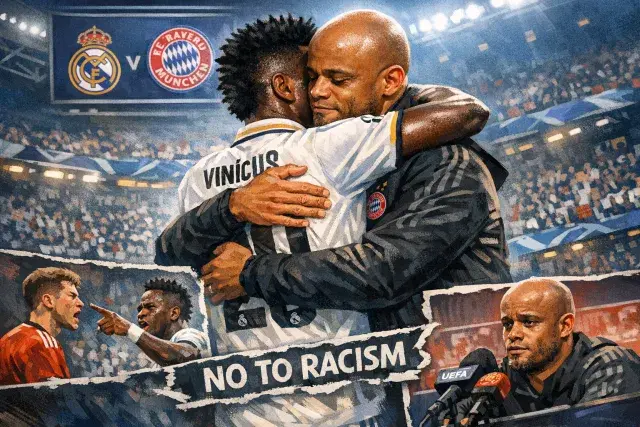
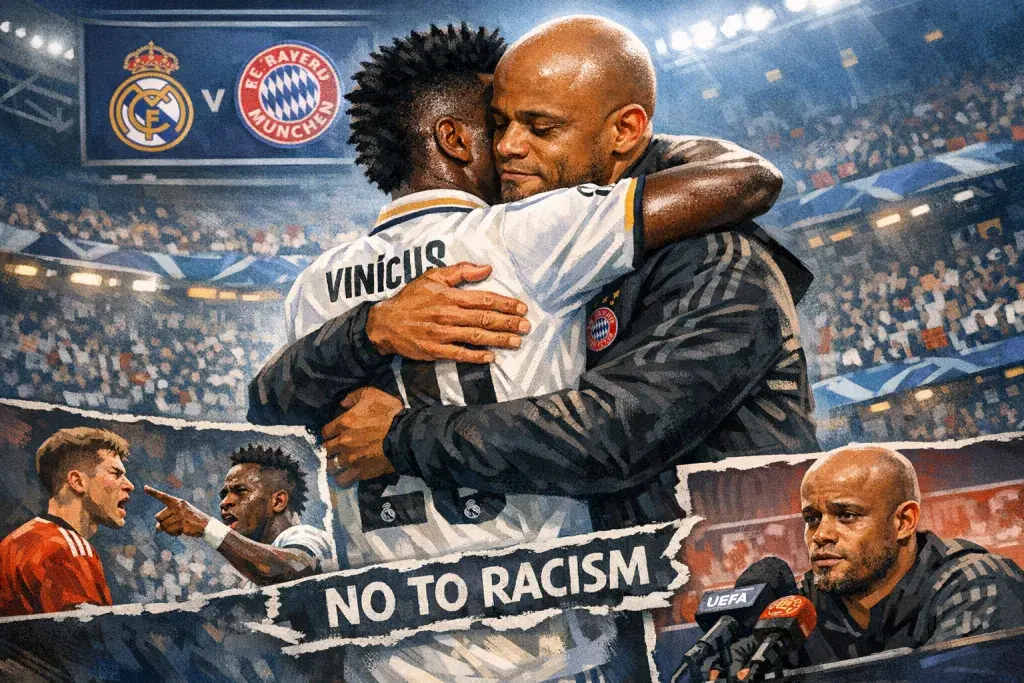
A brief but deliberate exchange at halftime of the UEFA Champions League quarter-final between Real Madrid and Bayern Munich carried weight far beyond the occasion itself. Vinícius Júnior walked toward Vincent Kompany, extended a hand, and pulled him into a hug — a wordless acknowledgment of something the two men had never previously discussed face to face. The gesture brought into public view a relationship built not on personal history but on principle.
What Prompted the Gesture
The context dates to a Champions League playoff encounter involving Benfica, during which Vinícius Júnior accused Argentine forward Gianluca Prestianni of directing racist abuse at him. The allegation opened yet another chapter in the recurring and deeply uncomfortable conversation about racism directed at Black footballers in European competition. Kompany, then managing Bayern Munich, responded publicly — not with vague diplomatic language, but with a clear condemnation. For a figure in his position to speak without equivocation on an incident that did not directly involve his club was notable. It reflected both personal conviction and an understanding that institutional silence in these moments carries its own meaning.
Vinícius has faced racist abuse on multiple occasions throughout his career in Europe, and his responses — whether appeals to governing bodies, public statements, or refusals to remain silent — have made him one of the most prominent voices on the issue in global football culture. His willingness to name incidents rather than absorb them quietly has drawn both support and criticism, often dividing opinion along lines that reveal more about the observer than about the conduct in question.
Respect Expressed Without Words
Kompany confirmed after the final whistle that the halftime exchange was their first in-person meeting. He described Vinícius in terms that went beyond professional admiration, stating that the sport requires individuals with distinctive personalities and that no criticism directed at such figures should cross ethical or human boundaries. The framing was deliberate: Kompany was not simply praising a gifted performer. He was restating the position he had already taken publicly — that opposition to racism is not conditional on circumstance, competition, or convenience.
The exchange between the two men was visible to cameras and quickly circulated widely, attracting attention because of what it represented rather than what it involved. Two individuals on opposite sides of a high-stakes European fixture pausing to acknowledge shared values is, in the context of elite competitive culture, an unusual sight. It carries the quality of a symbolic act precisely because it was unrehearsed and unsolicited.
A Broader Cultural Signal
Racism in European football has proved stubbornly resistant to eradication despite repeated institutional commitments, campaigns, and sanctions. Governing bodies have faced sustained criticism for the inconsistency and perceived inadequacy of their responses to reported incidents. Against that backdrop, individual acts of solidarity — particularly from those in positions of authority, such as a senior manager — take on added resonance. They signal, however modestly, that the responsibility to respond does not rest solely with those who are targeted.
Kompany's own background as a Black Belgian of Congolese descent lends his statements on the subject a specificity that is worth acknowledging. His career as one of Europe's most respected defensive presences spanned more than two decades, and his transition into management has been marked by a similar composure and clarity. When he spoke in support of Vinícius, it was not the reflex of someone performing an expected role. It was the position of someone who understands the experience from the inside.
The halftime embrace, brief as it was, encapsulated something the formal structures of European football have consistently failed to project: that solidarity against racism is a matter of individual character, and that it can cut across competition, nationality, and institutional affiliation without contradiction.